Thermal and CFD

4MULTIPHYSICS proficiently  tackles the thermal modelling of the electrical machines, providing expertise in the accurate representation of the motor’s thermal behaviour and the integration of the motor thermal model into the overall powertrain simulation framework.

In the recent years, we also focused on advanced cooling technologies, for compact and high-power density motors for the automotive sector, for both radial flux and axial flux topologies, addressing innovative concepts, while considering the compatibility with the overall thermal system architecture and the electric motor manufacturer’s specifications. We ensured their effectiveness in maintaining powertrain components within the desired temperature ranges, while minimizing cooling system complexity and power consumption.

Our simulation methodologies and hypotheses, as well as best practices, have been extensively validated throughout the years, thanks to the experimental testing at our clients’ facilities.

Analytical calculations

Pressure drop
Heat transfer
Cooling circuits dimensioning

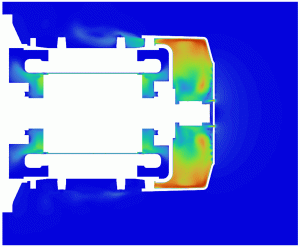
Thermal simulations – heat transfer:

Thermal conduction
Thermal convection
Radiation with simplified models

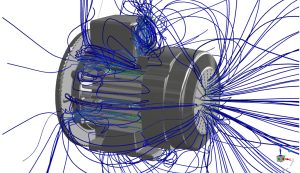
Fluid dynamics simulations – flow characterization

Assessments for fans, internal flow domain, housings
Assessments for various cooling fluids
Deflectors impact evaluation on flow, pressure and air distribution;
Fan absorbed power
Correlation between fan performance and thermal performance of the motor

Thermal & fluid dynamics complete simulations:

Advanced turbulence models
Fluid – structure interfaces
Anisotropic materials considered
Parametrized calculations

Several challenges addressed, specific to both radial-flux and axial-flux electrical machines, can be mentioned:

Determining the thermal resistance with respect to contact pressure between different components

Modelling anisotropic thermal conductivities on the copper coils

Air cooling though forced and natural convection (external and internal cooling solutions)

Liquid cooling though different water-jacket designs

Direct oil cooling with immersed stator/coils

Direct oil cooling of the rotor and stator though internal channels

VOF simulations with direct oil cooling (oil/air mixture): spray, impinging jet, gravity effects, splashing at high speed due to rotation

Determining friction losses thought VOF simulations between rotating components and oil, influence of oil inside the air gap

Detailed thermal modelling of EV inverters

Scroll to Top